
Dental Implants in Indiranagar & Marathahalli: What to Expect at Your Consultation
If you have a missing tooth, chances are you have already started researching your options.
You may have searched for dental implants in Indiranagar, dental implants in Marathahalli, or simply wondered, “Am I even a candidate for an implant?”
And then comes the next question:
What actually happens when I go for an implant consultation?
A dental implant consultation is not just about looking at the gap where a tooth is missing. It is about understanding your oral health, the condition of the supporting tissues and bone, your bite, your expectations and the different ways the tooth could be replaced.
At Lifetime Dental, we believe the first consultation should give you clarity before commitment.
You should leave knowing what is happening, what your options are, what may be involved in treatment and what the next step should be.
Here is what you can expect.

What happens at a dental implant consultation?
01 — Talk
We understand your dental history, concerns and expectations.
02 — Examine
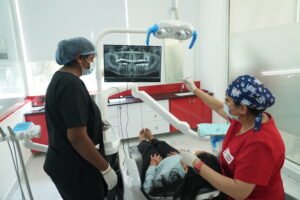
Your teeth, gums, bite and the proposed implant site are assessed.
03 — Assess
Appropriate dental imaging may be recommended when it is clinically indicated.
04 — Plan
We discuss whether an implant is appropriate and what alternatives may be available.
05 — Decide
You understand the proposed treatment, expected timeline, investment and aftercare before deciding how to proceed.
- It starts with a conversation — not a procedure
Before recommending an implant, your dentist needs to understand your situation.
You may be asked:
- When did you lose the tooth?
- Why was the tooth removed?
- Have you had an infection or other problem in that area?
- Have you had any previous treatment there?
- Are you missing one tooth or several?
- Are you having difficulty chewing?
- Are you concerned about the appearance of the missing tooth?
- Have you previously considered or undergone any tooth-replacement treatment?
Your dentist may also ask about your general health, medications and relevant medical history.
This matters because implant treatment is not planned in isolation. Factors affecting your oral and general health can influence how treatment is approached and when it should be carried out.
The first goal is therefore not to decide “implant or no implant” in five minutes. It is to understand your individual situation.
- Your gums, teeth and bite will be examined
A missing tooth affects more than the space it leaves behind.
Your dentist will assess the area around the missing tooth as well as the neighbouring teeth and supporting tissues.
This may include evaluating:
- The condition of your gums
- Signs of gum disease or inflammation
- The health of neighbouring teeth
- The amount of space available for the replacement tooth
- Your bite and tooth alignment
- Existing crowns, bridges or fillings
- The condition of the tissues around the proposed implant site
This step is particularly important because an implant is only one part of the final result.
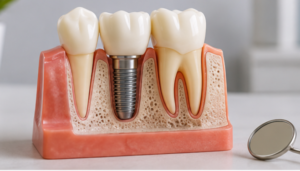
The implant, surrounding tissues and final crown or prosthesis all need to be considered together.
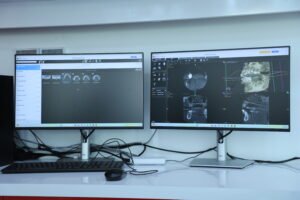
3. Your bone and implant site will be assessed
One of the most important parts of implant planning is understanding the anatomy of the proposed implant site.
After tooth loss, the bone in the area can undergo changes in shape and volume over time. The amount and anatomy of available bone therefore need to be assessed as part of treatment planning.
Your dentist may recommend dental imaging based on your clinical findings.
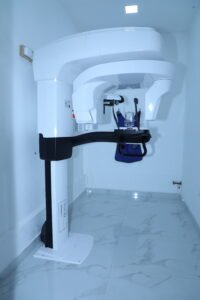
This could include conventional dental X-rays or, where appropriate, three-dimensional imaging such as a CBCT scan.
CBCT can provide detailed information about the proposed implant site, including bone dimensions and the relationship of the site to important anatomical structures.
Importantly, any imaging should help answer a clinical question. Current ADA/AAOMR recommendations emphasise that a patient’s history and clinical findings should be assessed before imaging, previously obtained images should be reviewed where relevant, and imaging — particularly CBCT — should be used judiciously to minimise unnecessary cumulative radiation exposure.
In other words, imaging should be part of treatment planning — not simply another routine step.
- Your dentist will assess whether an implant is appropriate for you
Not every missing tooth automatically needs an implant.
Depending on your circumstances, possible options may include:
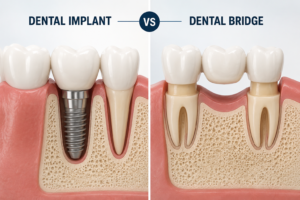
- A single dental implant with a crown
- Multiple dental implants
- A conventional dental bridge
- A removable partial denture
- An implant-supported restoration
The appropriate choice can depend on the health of your remaining teeth, gums, available bone, bite, aesthetics, function, general health and your own priorities.
That is why a good implant consultation should explain why a particular option is being recommended and what the alternatives are.
For some patients, an implant may be the most appropriate option. For others, another form of tooth replacement may make more sense.
The decision should be based on your individual clinical situation — not simply on the fact that implants are available.
Not sure whether an implant is right for you?
You don’t have to decide before your first appointment.
A consultation can help you understand whether an implant is appropriate for your situation, what alternatives may be available and what your treatment could involve.
Book a dental implant consultation at Lifetime Dental.
Indiranagar: +91 77958 23300 / 080 4203 5021
Marathahalli: +91 98454 14281 / 080 4112 1397
- You may need treatment before the implant
Sometimes the implant is not the first step.
Your dentist may identify something that needs to be addressed before implant placement, such as:
- Active gum disease
- An infection
- A tooth that needs treatment or removal
- Inadequate bone volume at the proposed site
- Problems with the bite or available space
- Other oral health concerns
In some cases, additional procedures such as bone augmentation may be considered.
This does not necessarily mean that an implant is no longer possible.
It may simply mean that your treatment needs to be staged differently.
Good implant planning is about preparing the conditions for treatment rather than rushing to place an implant.
- Your treatment may not follow the same timeline as someone else’s
One of the most common questions patients ask is:
“How long will my dental implant take?”
There isn’t one answer that applies to everyone.
A simplified implant journey might look like:
Assessment → Planning → Implant placement → Healing → Final restoration
But real treatment can vary.
Depending on the clinical situation, an implant may be placed at the time of tooth extraction or after a period of healing. Some patients may require additional procedures before implant placement. The timing of the final crown can also depend on factors such as implant stability, healing and the overall treatment plan.
So rather than asking only, “How many days will it take?”, ask your dentist:
“What will my treatment sequence look like, and why?”
That gives you a much more useful answer.

7. Your dentist should explain what you can realistically expect
Dental implants can provide a durable way to replace missing teeth, but they are not maintenance-free and are not a guarantee against future dental problems.
Your dentist should discuss the expected benefits as well as the limitations and potential complications relevant to your case.
These can include problems with healing or integration, infection or inflammation around the implant, mechanical or restorative complications, and the possibility that additional treatment may sometimes be required.
Certain factors can also increase the risk of peri-implant disease. These include a history of periodontitis, smoking, uncontrolled diabetes, inadequate plaque or biofilm control and certain site-related or prosthetic factors.
This is why an implant consultation should be an informed decision-making process, rather than simply a discussion about placing a tooth.
- Maintenance is part of the treatment
Getting the implant placed is not the end of the journey.
Once the final restoration is in place, maintaining the health of the gums and tissues around the implant becomes an important part of long-term care.
Your dentist may recommend:
- Regular dental examinations
- Professional cleaning where appropriate
- Good daily oral hygiene
- Monitoring of the tissues around the implant
- Periodic assessment of the implant and restoration
The Indian Society of Periodontology’s clinical recommendations emphasise ongoing peri-implant maintenance, monitoring and appropriate home care. Recent AO/AAP consensus recommendations likewise identify supportive peri-implant maintenance as an important component of long-term peri-implant tissue health.
So when considering an implant, don’t just ask:
“How long will the implant last?”
Also ask:
“What will I need to do to look after it?”
That is a much more useful question.
What should you bring to your implant consultation?
If you have previous dental records or scans, bring them along. They may help your dentist understand your treatment history and determine whether existing imaging is relevant.
It can also be useful to bring:
- Previous dental X-rays or scans
- Details of previous dental treatment
- A list of current medications
- Relevant medical information
- Questions you want to ask
And don’t worry if you don’t know what to ask.
Your dentist should be able to guide the conversation and explain what is relevant to your case.
10 questions to ask before getting a dental implant
If you’re considering dental implants in Indiranagar or Marathahalli, these questions can help you make a more informed decision.
- Am I a suitable candidate for an implant?
Ask what factors make you suitable — or what needs to be addressed first.
- How healthy are my gums and neighbouring teeth?
The health of the surrounding tissues matters to the overall treatment plan.
- Do I have sufficient bone at the implant site?
If not, ask whether there are ways to address the deficiency and how that would change the treatment.
- Do I need a CBCT or other imaging?
Ask what the imaging is intended to show and how it will affect treatment planning.
- Are there alternatives to an implant for me?
An implant may be recommended, but you should understand the reasonable alternatives too.
- What will the treatment involve?
Ask your dentist to explain the stages in simple terms.
- How long is my expected treatment timeline?
Ask what could make the timeline shorter or longer.
- What are the risks or complications in my particular case?
The answer should be specific to you rather than a generic list.
- What will the total treatment cost include?
Ask whether the quoted amount includes the implant, abutment, crown, imaging and any additional procedures that may be required.
- What maintenance will I need afterwards?
Understanding aftercare before treatment begins can help you make a more informed decision.
Choosing a dental implant clinic in Indiranagar or Marathahalli
Location is a practical consideration, but it is not the only one.
Implant treatment can involve more than one appointment, including assessment, treatment, restoration and follow-up. Choosing a clinic that is convenient for you can make it easier to attend the appointments needed throughout your treatment.
At Lifetime Dental, implant treatment is supported by a multi-specialty dental team with expertise across areas including implantology, prosthodontics, periodontics, oral medicine and radiology.
You can visit us at either of our Bengaluru locations.
Lifetime Dental — Indiranagar
Ground Floor, Carlton Tower, HAL Old Airport Road, HAL 2nd Stage, Indiranagar, Kodihalli, Bengaluru – 560008.
Call: +91 77958 23300 / 080 4203 5021
Lifetime Dental — Marathahalli
Purva Riveria Commercial Complex, Lakshminarayana Pura, Marathahalli, Bengaluru – 560037.
Call: +91 98454 14281 / 080 4112 1397
A consultation should give you clarity — not pressure
If you have been putting off replacing a missing tooth because you aren’t sure whether an implant is right for you, the first step doesn’t have to be making a decision.
It can simply be getting assessed.
A proper consultation can help you understand:
Your oral health.
Your bone and implant site.
Your treatment options.
Your expected timeline.
The benefits and limitations.
Your investment and aftercare.
Once you have that information, you can decide what makes sense for you.
Considering dental implants in Indiranagar or Marathahalli?
Book an implant consultation at Lifetime Dental and speak with our dental team about your individual treatment options.
Indiranagar: +91 77958 23300 / 080 4203 5021
Marathahalli: +91 98454 14281 / 080 4112 1397
Your smile. Your bone. Your treatment plan.