


Looking at the Whole Picture: CBCT is a Dental CT-Scan which takes 3D images of Head and Neck region.
Imagine the human head and neck, not as a two-dimensional drawing, but as a complicated, three-dimensional sculpture. It’s a place with detailed structures—bones, nerves, muscles, and tissues—all stacked and intertwined. Dentistry used to depend on old 2D X-rays, which are similar to viewing that sculpture from one angle. You can observe much, but you cannot quite comprehend the depth, the interdependency among various parts, or what lies hidden behind another edifice.
This is where the magic of Cone-Beam Computed Tomography (CBCT) comes in. CBCT is a remarkable technology that allows dentists to go beyond a flat image and see the head and neck as the 3D structure it truly is. By providing a complete, volumetric view, CBCT has revolutionized dental care, making it safer, more accurate, and more predictable.
What is CBCT?
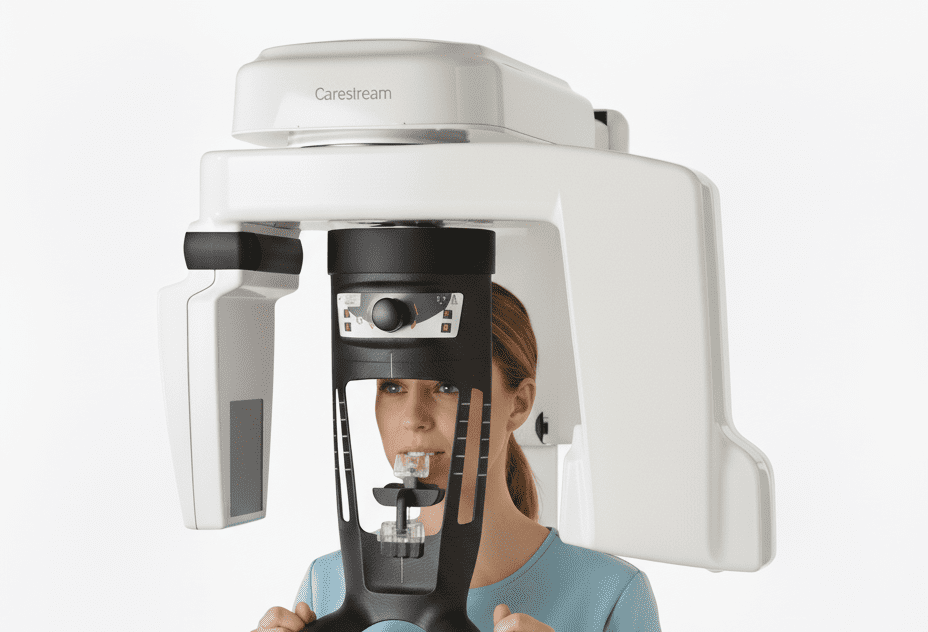
CBCT is a dedicated X-ray unit that employs a cone-beam to take a whole, 3D image of a patient’s jaw, and mouth. While scanning for less than a minute, the machine circles around the head of the patient. It builds hundreds of images, which a computer then assembles into a very detailed, three-dimensional model of their anatomy.
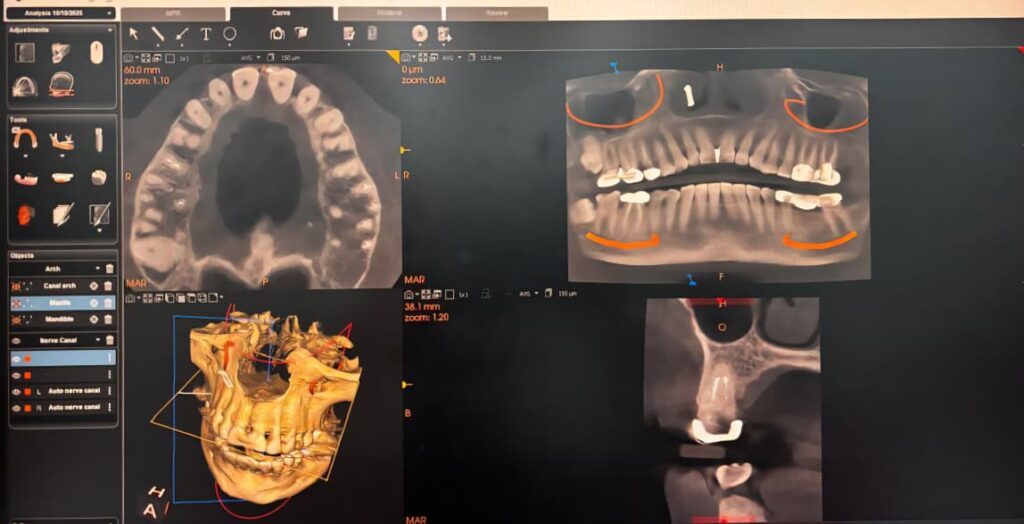
This 3D perspective provides a dentist with an enormous amount of data that a normal X-ray just can’t. It allows them to visualize the precise location of a patient’s teeth, the contours of their jawbones, the position of nerves, and even underlying infections.
CBCT vs. OPG: Why 3D is Better than 2D
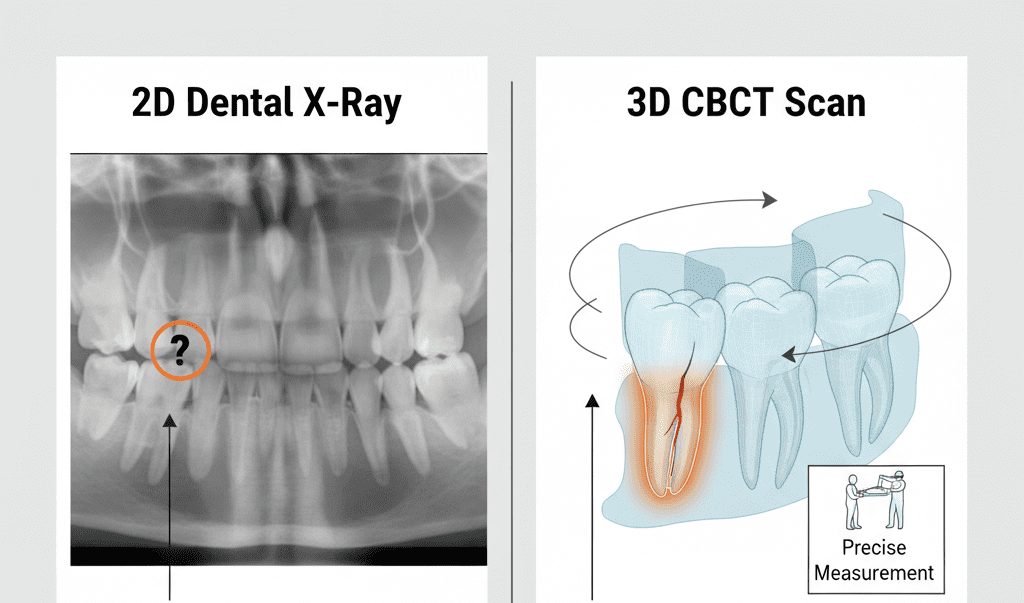
An old-fashioned Orthopantomogram (OPG) is one of the most popular dental X-rays and gives an overview of the complete upper and lower jaws in a single, wide image. An OPG is a great resource for the big picture—displaying all the teeth, jawbones, and sinuses in one photo—but it is nevertheless a 2D representation of a 3D complex. This makes it prone to magnification, distortion, and the overlap of various anatomy parts, obscuring important details.
This is where the advantage of CBCT lies. A CBCT scan does away with these problems by giving a real 3D image. It enables a dentist to see a patient’s anatomy from any direction, eliminating guesswork due to overlapping structures. This gives much more accurate bone measurements, accurate nerve localization, and a better view of whatever problem may be present, and this is critical for advanced treatment planning.
How CBCT is Revolutionizing Dental Care:
CBCT is a valuable solution for certain procedures where an accurate diagnosis is essential for complex cases.
How CBCT is revolutionizing Dentistry:
1.For Dental Implants:
Preparing an implant is similar to constructing a house. You want to know that the foundation is solid and where all the critical pipes and wires are. CBCT enables a dentist to measure jawbone density exactly and precisely map out nerves and sinuses. This enables them to select the ideal location and size for the implant, making the process safer and more effective.
2.For Root Canals:
Root canals may be difficult because some teeth contain extremely intricate, small passageways. A 3D scan assists a dentist in locating all the concealed canals and root fractures that a standard X-ray cannot detect, resulting in more complete and efficient treatment.
3.For Detecting Cracks:
CBCT (Cone-Beam Computed Tomography) provides a three-dimensional (3D) view of the tooth structure, it offers significant advantages in detecting vertical & horizontal dental cracks, especially difficult fractures like vertical root fractures. Clinicians can more clearly see the depth, scope, and orientation of the crack thanks to this 3D capability, which removes the anatomical superimposition that restricts traditional 2D X-rays. Furthermore, when clinical and 2D radiographic findings are unclear, CBCT improves diagnostic accuracy by better detecting the subtle periradicular(around the roots) bone loss patterns that frequently accompany longitudinal tooth fractures.
4.For Oral Surgery:
If a dentist is required to extract a wisdom tooth or other impacted teeth, a CBCT scan indicates its precise location and how near it is to critical structures like nerves etc. This enables them to map out the surgery in order to reduce risks and make the procedure go more smoothly.
5.For Oral Cysts and Tumors:
CBCT is a crucial tool for assessing oral cysts and tumors. In contrast to 2D pictures, a 3D CBCT scan is able to precisely depict the size, form, and extent of a lesion, along with how it has impacted upon adjacent bone as well as its association to major structures such as nerves and roots of teeth. It offers important information regarding the borders of a lesion, internal characteristics, as well as cortical bone involvement. This data is used by the oral surgeon to formulate a precise surgical plan so that all of the lesion is excised, which is essential in eliminating recurrence and conserving healthy tissue.
6.For TMJ Disorder:
CBCT is very useful in diagnosing Temporomandibular Joint(TMJ) disorder since it delivers high-resolution, three-dimensional (3D) images of the bony structures of the joint with great accuracy, enabling the exact identification of degenerative changes such as erosion, flattening, and osteophytes, a vast improvement from traditional 2D X-rays.
7.For Orthognathic Surgery:
By providing better 3D visualization of the craniofacial anatomy and removing the distortions of 2D X-rays, CBCT is revolutionizing orthognathic surgery. This detail makes it possible for Virtual Surgical Planning (VSP) to create custom surgical guides, precisely localize important structures like the inferior alveolar nerve, and simulate jaw movements. All of these things greatly improve the predictability and accuracy of the surgery for better functional and aesthetic patient outcomes.
It’s the difference between navigating with a paper map and using a GPS with a 3D satellite view. This powerful perspective ensures that every decision is based on a complete understanding of a patient’s unique anatomy, leading to safer, more accurate, and more predictable dental care.
All in all, CBCT is an outstanding technology that facilitates safer, more precise, and more predictable dental treatment, particularly in complicated situations. It’s a very important component of today’s dentistry’s promise of delivering the best possible care.